Safe, Durable, and Desert-Engineered Concrete Paths for Residential and Commercial Properties
A front walk is the first part of a house anybody steps on, and we pour a lot of them at St. George Concrete Specialists. Sidewalks, side yard paths, the walk out to a pool or a back gate. It looks like the simplest pour there is. It is not, because a walkway shows every shortcut. If the ground under it moves, one panel tips, and now there is a lip waiting for somebody's toe.
Most of the walks we pour are front entries and yard paths on houses, and commercial sidewalks when a business needs them. The price depends on the finish you pick, plain broom, exposed aggregate, or stamped to match a patio, and you get the whole price in writing before we start. If a panel ever heaves or settles because of how we built it, that is on us to make right.
BeforeAfter↔
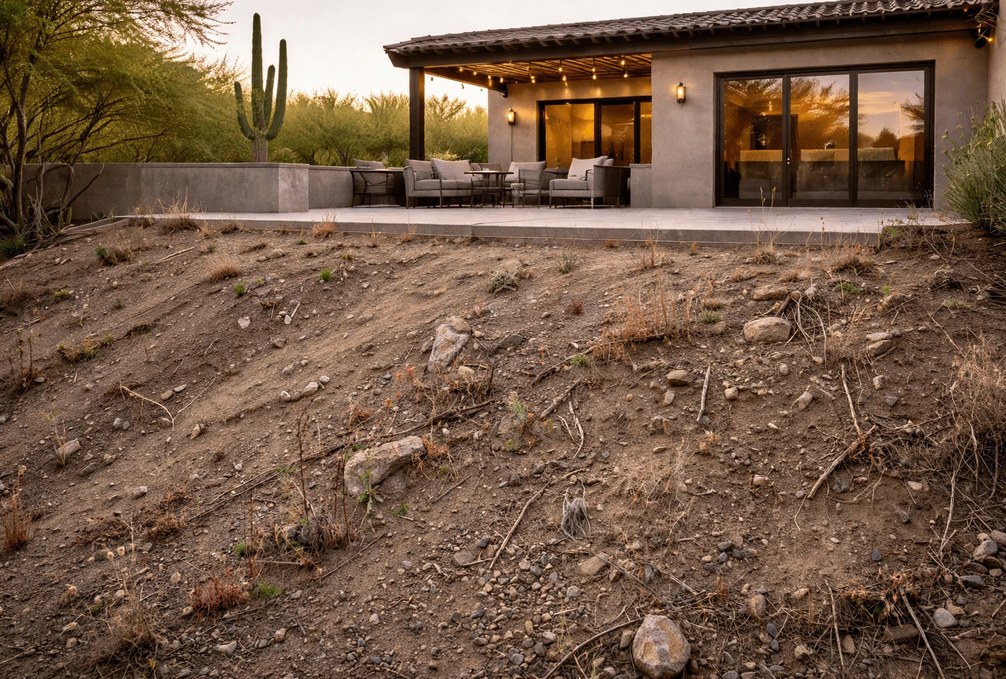
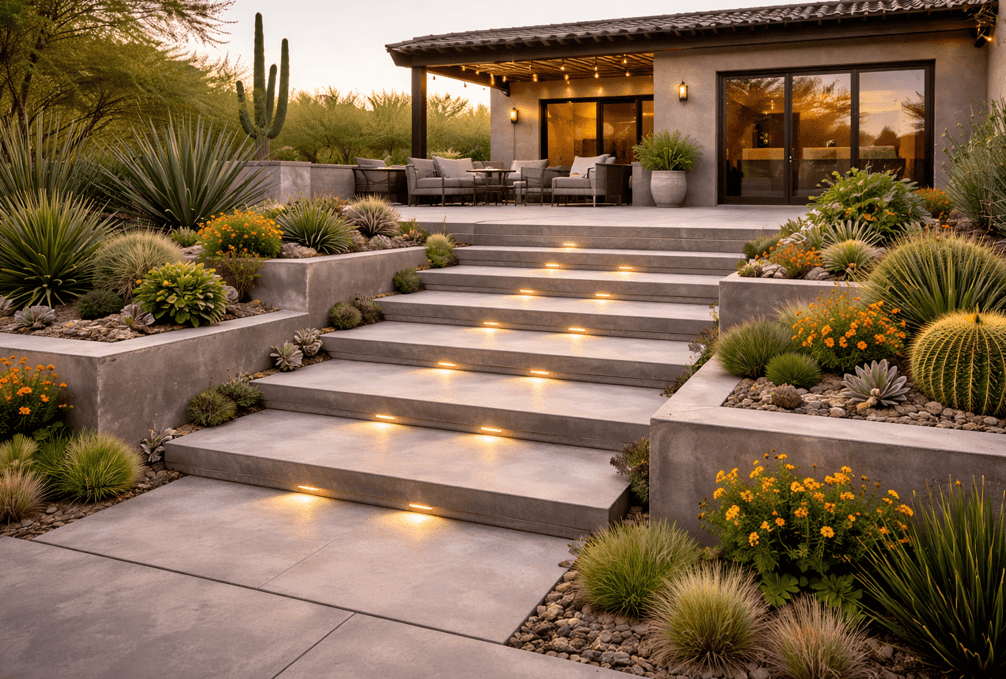
The same backyard, before and after a set of terraced steps went in. It started as a bare dirt slope under the patio. The steps are wide concrete treads with a light under each nosing, and the planters holding the hill on both sides are poured concrete too.
The ground here moves. The clay in this valley swells when it gets wet and shrinks back when it dries, and a thin path poured straight on top of it will ride that movement until it cracks. So the work that matters on a walkway is mostly the work underneath. We dig out the soft ground, compact a base, and put steel or fiber in the pour so the panels hold together when the soil does what it does.
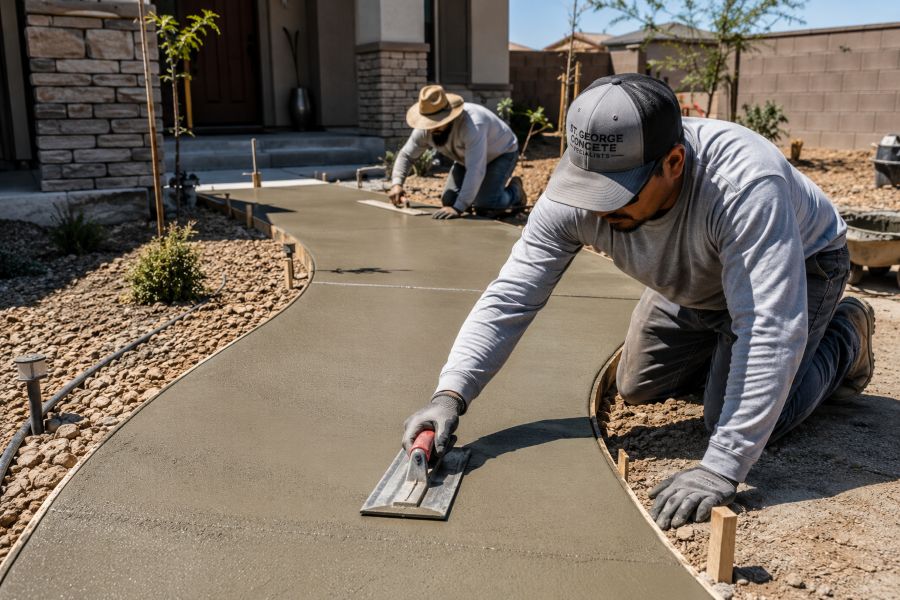
The joints get cut where a crack belongs, in straight lines at the panel breaks, instead of letting the slab pick its own places. The finish stays broom rough so the walk is not slick when it is wet, and the slope runs water away from the house and off the path instead of across it. In the summer the pour starts early, same as everything else we do, so the surface does not dry out before it is finished.
Concrete Contractor in St. George, UT & Surrounding Areas
Proudly Serving St. George and Nearby Southern Utah Communities
At St. George Concrete Specialists, we provide professional residential and commercial concrete services throughout St. George, Utah and surrounding areas within approximately 30 miles. As a local contractor, we understand the unique soil conditions, climate, and construction needs across Southern Utah, allowing us to deliver concrete work that is built to last.
Whether you’re located in a growing neighborhood, a rural property, or a commercial development, our team brings the same level of quality, precision, and reliability to every project.
Tell us a little about your project and we’ll follow up to discuss the details.
Walkway Construction That Performs
Concrete Mix Design (Built for Desert Conditions)
Walkway concrete in St. George has to perform under extreme conditions: heat, UV exposure, soil movement, and seasonal temperature swings. Because of that, the mix design is not a place to cut corners.
We use 4,000 PSI concrete with a low water-cement ratio to improve strength and reduce surface deterioration over time. Air-entraining admixtures are included to handle freeze-thaw cycles, while water-reducing agents allow proper workability without weakening the mix.
These specifications are not upgrades—they are what allow a walkway to hold up long-term in southern Utah without premature cracking or scaling.
Thickness and Reinforcement
The structural strength of a walkway comes from both its thickness and how it is reinforced.
Residential walkways are typically installed at four inches thick, while commercial sidewalks are increased to four and a half to five inches depending on expected use. Reinforcement, either rebar or welded wire, is placed at mid-slab depth, where it actually provides tensile strength.
What matters most isn’t just having reinforcement, it’s placing it correctly. Improper placement is one of the most common causes of early failure, even when the right materials are used.
Subgrade Preparation (What Keeps Walkways Flat)
Most walkway issues—settling, cracking, uneven surfaces—start below the concrete.
We prepare the subgrade by excavating to the correct depth, removing unstable or expansive soils, and installing a compacted aggregate base. This creates a consistent foundation that supports the slab evenly over time.
Special attention is given to edges and tree proximity, where root systems and inconsistent soil conditions can lead to lifting or separation if not addressed during the planning stage.
Control Joints (Preventing Random Cracking)
Concrete naturally expands and contracts with temperature changes, and in St. George, those movements are significant.
We install control joints at intervals equal to the width of the walkway, creating balanced sections that reduce stress and guide cracking to planned locations. In decorative walkways, joints are aligned with pattern lines so they blend into the design rather than disrupt it.
This approach keeps the surface looking clean while preventing random cracking across the finished walkway.
Walkway Finish Options
The finish applied to a walkway affects both its appearance and its safety. In St. George, traction and durability are just as important as how the surface looks.
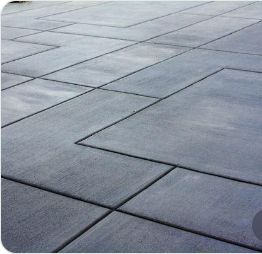
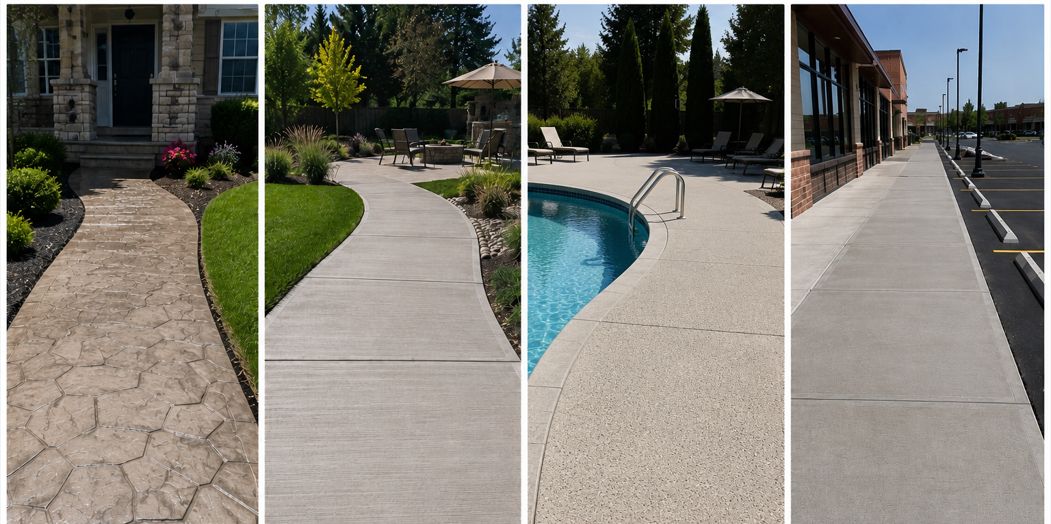
A broom finish remains the most common and reliable option for both residential and commercial walkways. It provides consistent slip resistance in wet conditions and requires virtually no maintenance over time.
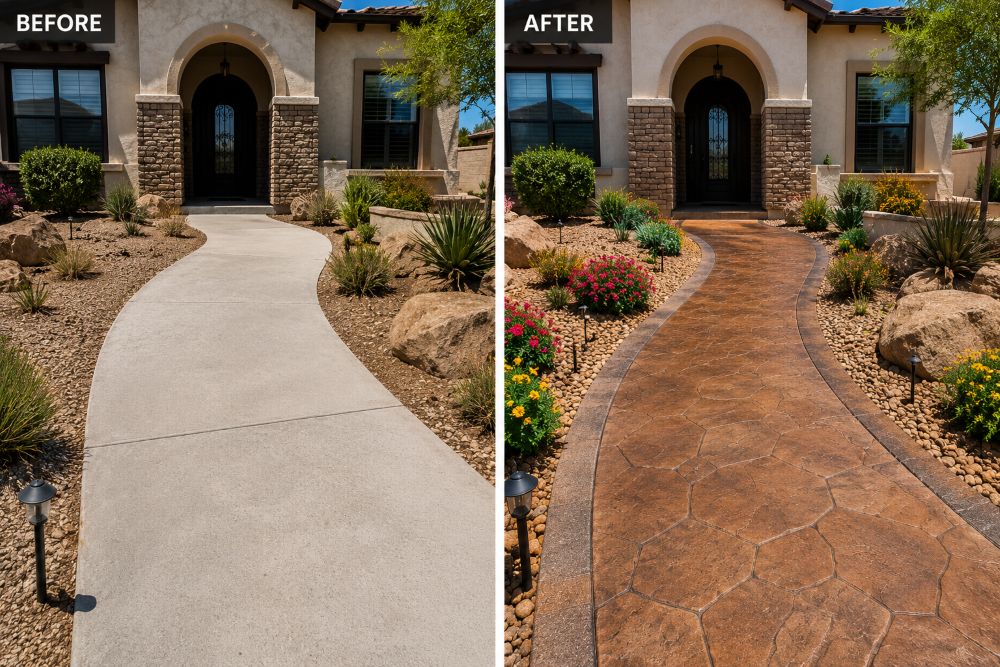
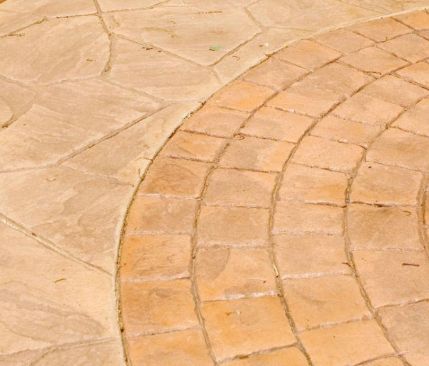
For higher-end applications, stamped and decorative finishes can be used to match surrounding hardscape and architectural style. These surfaces incorporate color, texture, and pattern while still maintaining proper traction through the use of slip-resistant additives.
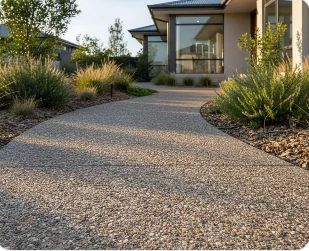
Exposed aggregate finishes offer a more natural look and excellent traction without relying on sealers, making them a strong option for landscape paths and pool-adjacent areas. Colored concrete provides a simpler design upgrade, using integral pigment to create a consistent tone that complements the property without the added cost of full decorative work.
The right finish depends on how the walkway will be used, where it’s located, and how it integrates with the rest of the property.
Popular Walkway Applications in St. George
Where does a walkway earn its keep at your place? These are the four jobs we pour most.
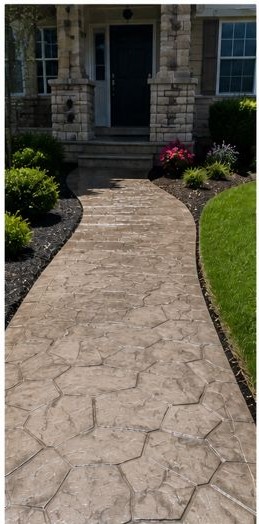
Residential Front Entry Walkways
The first impression of a home.
A well-designed entry path:
Improves curb appeal
Connects driveway to entrance
Matches the home's architecture
Stamped, colored, or broom finishes can all be used depending on style and budget.
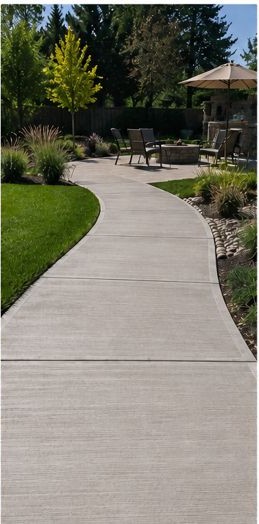
Backyard and Landscape Paths
Concrete walkways provide a durable alternative to gravel or stepping stones.
Weed-free and low maintenance
Stable surface that won't shift
Clean transitions between outdoor spaces
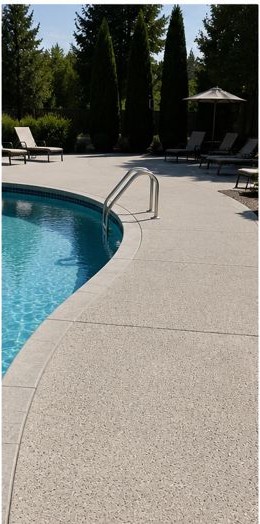
Pool Area Walkways
Walkways around pools require special consideration.
Slip-resistant surfaces
Resistance to water and chemicals
Durable under constant exposure
We prioritize traction and safety in all pool-adjacent installations.
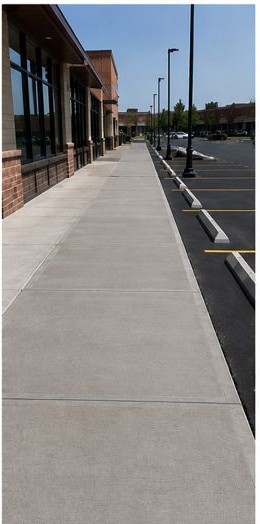
Commercial Sidewalks and Site Circulation
Commercial walkways must meet higher standards.
Wider paths for traffic flow
Durable finishes for long-term use
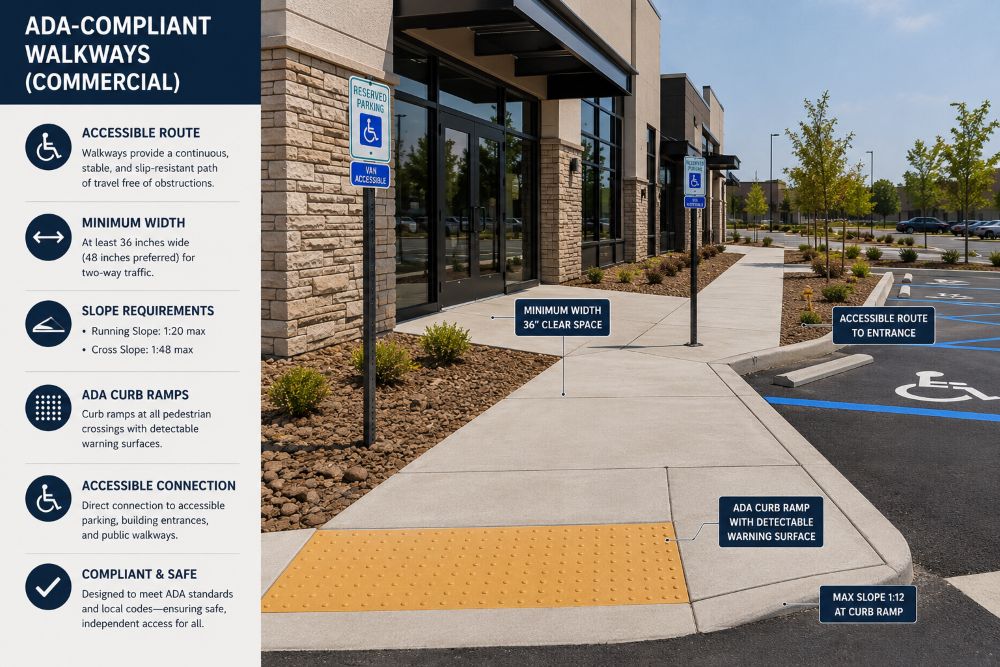
ADA-compliant design and layout
We install sidewalks for retail, office, and multi-family properties throughout Washington County.
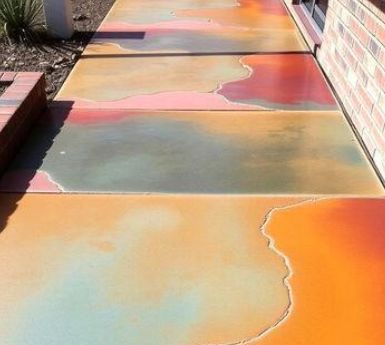
Reading a finished walk.Tap a numbered marker on the photo. Four things on this one stained walkway are doing more work than they look like.
Popular Walkway Applications in St. George
Residential Front Entry Walkways
The first impression of a home.
A well-designed entry path:
Improves curb appeal
Connects driveway to entrance
Matches the home’s architecture
Stamped, colored, or broom finishes can all be used depending on style and budget.
Backyard and Landscape Paths
Concrete walkways provide a durable alternative to gravel or stepping stones.
Weed-free and low maintenance
Stable surface that won’t shift
Clean transitions between outdoor spaces
Pool Area Walkways
Walkways around pools require special consideration.
Slip-resistant surfaces
Resistance to water and chemicals
Durable under constant exposure
We prioritize traction and safety in all pool-adjacent installations.
Commercial Sidewalks and Site Circulation
Commercial walkways must meet higher standards.
Wider paths for traffic flow
Durable finishes for long-term use
ADA-compliant design and layout
We install sidewalks for retail, office, and multi-family properties throughout Washington County.
ADA-Compliant Walkways (Commercial)
Commercial sidewalks must meet ADA and building code requirements.
We design for:
Maximum running slope of 5%
Cross slope under 2%
Minimum width requirements
Smooth, accessible transitions
We also install detectable warning panels at crossings and ramps where required.
Proper compliance reduces liability and ensures accessibility for all users.
On commercial work the walks have to meet the federal accessibility guideline, and one number in it matters more than the rest. A vertical lip of more than half an inch between panels counts as a hazard, and anything over a quarter inch has to be beveled. We build to that number on commercial sidewalks, and we hold it on house walks too.
Serving St. George & Surrounding Areas
From St. George to Washington, Santa Clara, Ivins, Hurricane, La Verkin, Leeds, Toquerville, we install sidewalks and walkways built for long-term performance in Southern Utah’s climate.
If you don’t see your city listed, give us a call. We also serve surrounding communities throughout the area.
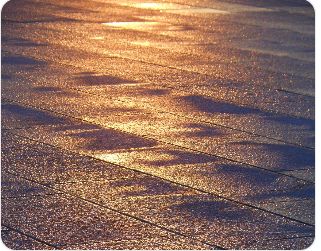
Surface temperature is a major factor in walkway performance and usability in St. George. Darker concrete absorbs heat and can become extremely hot in direct summer sun, often uncomfortable to walk on and radiating heat into surrounding areas.
Lighter color selections reflect more sunlight and stay significantly cooler under the same conditions. That difference has a real impact on how often the walkway is used, especially during peak summer months.
Drainage and Monsoon Rain
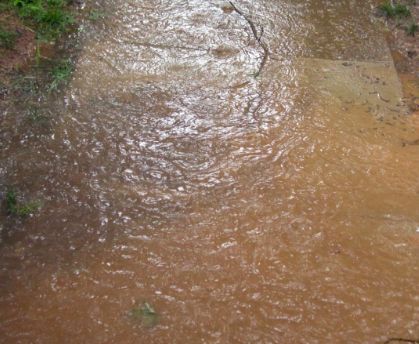
Walkways in St. George must be designed to handle intense, short-duration rainfall during monsoon season. Without proper drainage, water can collect on the surface or flow toward structures, creating both safety and long-term performance issues.
We design walkway slopes to move water away from the home and toward controlled drainage paths. The goal is a surface that sheds water quickly and performs correctly even during heavy rainfall events—not just under normal conditions.
Tree Roots and Soil Movement
Tree roots and soil movement are two of the most common causes of walkway failure in residential settings. As root systems expand, they can lift and crack concrete from below, creating uneven and unsafe walking surfaces.
We evaluate tree proximity during the planning phase and adjust the design accordingly. This may include rerouting the walkway, improving subgrade preparation, or installing root barriers to reduce long-term risk.
Walkway Installation Cost in St. George, UT
Walkway installation costs vary depending on the condition of the existing site, the finish selected, and the level of preparation required. In St. George, factors like heat, soil movement, and drainage all play a role in how the project is built and priced.
Typical ranges
Basic broom finish$8 – $14 per sq ft
Decorative / stamped concrete$14 – $25+ per sq ft
Exposed aggregate$12 – $20 per sq ft
Site prep / repairs (if needed)Priced by condition
Final pricing depends on layout, access, and how the walkway needs to perform over time, not just the surface finish.
What affects walkway cost most
Site preparation (grading, demolition, root removal)
Walkway width, layout, and complexity
Finish type (broom, stamped, aggregate, colored)
Drainage design and slope requirements
Soil conditions and long-term stability needs
ADA or commercial code requirements
Get a Clear, Accurate Estimate
We evaluate your site conditions, layout, and usage to recommend the right system, not just a surface that looks good, but one that performs long-term in St. George's climate.
Every project is evaluated on-site so we can provide a clear, accurate estimate based on how the walkway will actually be used and built.
Walkway installation costs vary depending on the condition of the existing site, the finish selected, and the level of preparation required. In St. George, factors like heat, soil movement, and drainage all play a role in how the project is built and priced.
Typical ranges:
Basic broom finish: $8–$14 per sq ft
Decorative / stamped concrete: $14–$25+ per sq ft
Exposed aggregate: $12–$20 per sq ft
Site prep / repairs (if needed): priced based on condition
Final pricing depends on layout, access, and how the walkway needs to perform over time—not just the surface finish.
What Affects Walkway Cost Most
Site preparation (grading, demolition, root removal)
Walkway width, layout, and complexity
Finish type (broom, stamped, aggregate, colored
Drainage design and slope requirements
Soil conditions and long-term stability needs
ADA or commercial code requirements
Get a Clear, Accurate Estimate
We evaluate your site conditions, layout, and usage to recommend the right system—not just a surface that looks good, but one that performs long-term in St. George’s climate.
Every project is evaluated on-site so we can provide a clear, accurate estimate based on how the walkway will actually be used and built.
Common Walkway Mistakes in St. George
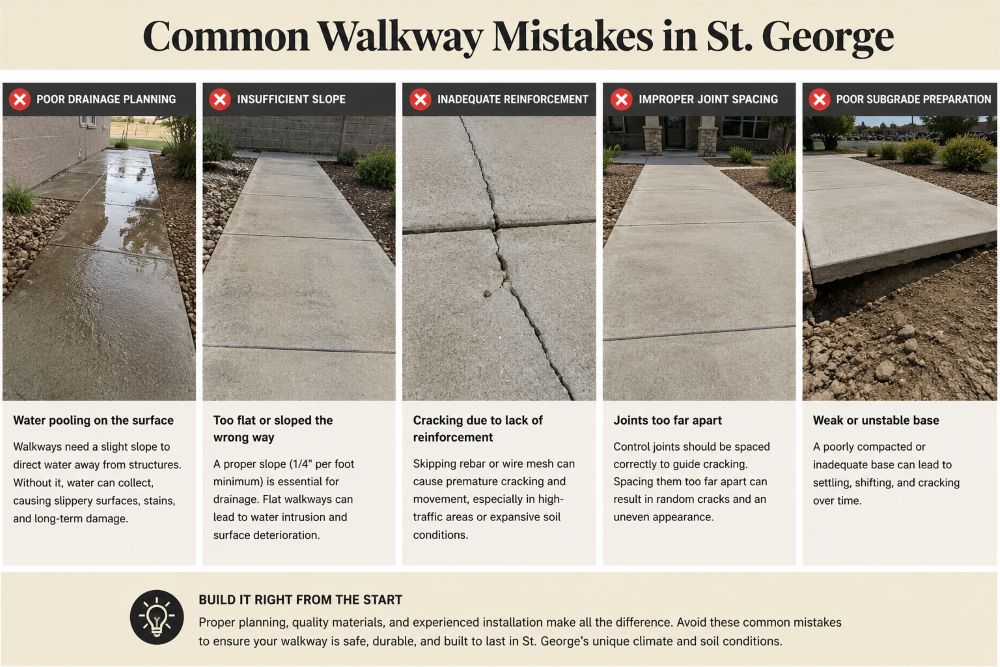
Most walkway problems aren’t caused by the concrete itself, they’re the result of design and installation decisions that don’t account for local conditions.
Poor drainage planning is one of the most common issues. Without proper slope, water can collect on the surface or flow toward structures, leading to long-term damage and safety concerns.
Improper reinforcement placement is another frequent problem. Even when reinforcement is included, placing it at the bottom of the slab instead of mid-depth significantly reduces its effectiveness.
Tree roots and soil movement are often overlooked during planning. In many St. George neighborhoods, root systems can lift and crack walkways over time if routing and subgrade preparation aren’t handled correctly.
Control joint spacing is also critical. Joints that are too far apart or poorly placed allow cracks to form randomly instead of in controlled, planned locations.
A properly designed walkway addresses these factors from the start, resulting in a surface that stays level, drains correctly, and maintains its appearance over time.
Why Choose St. George Concrete Specialists
Built for the Desert
Our specifications are designed for St. George’s climate—not generic standards.
Proper Subgrade and Reinforcement
We focus on what’s below the surface as much as the finish.
Integrated Design Approach
Walkways are designed to match your property—not added as an afterthought.
ADA and Commercial Expertise
We install compliant walkways for commercial properties across Washington County.
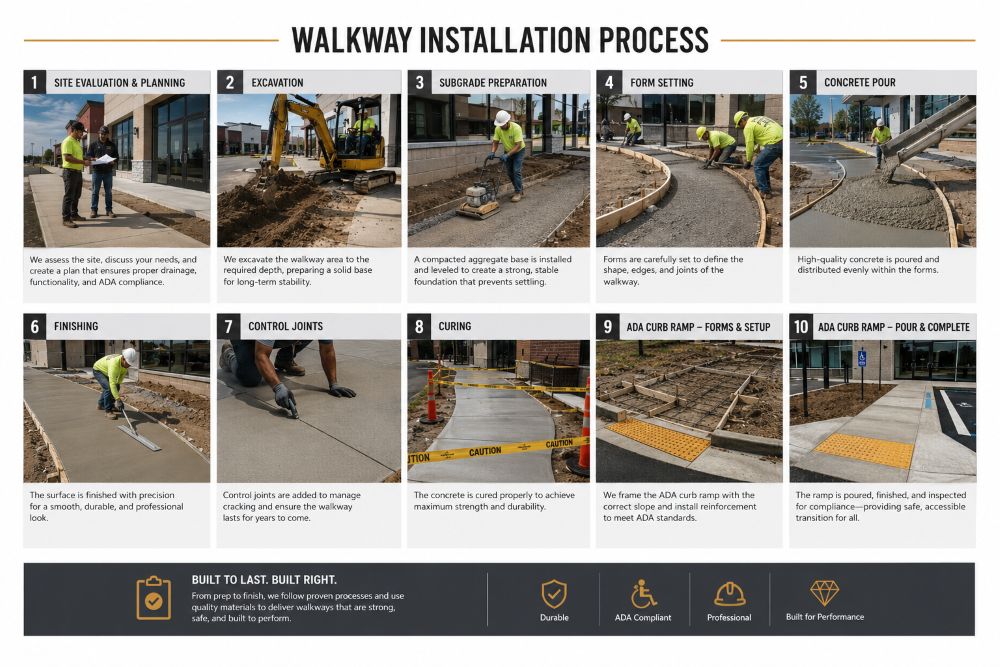
How a Walkway Gets Built, Step by Step
Six steps, in the order they happen at your place.
Step 1
Site Evaluation and Layout
We assess grade, drainage, soil conditions, and design the path.
Why it matters: most walkway failures are decided here, in the grade and the drainage, before any concrete shows up.
Step 2
Excavation and Base Preparation
Subgrade is prepared and compacted for long-term stability.
Why it matters: a compacted base keeps the slab from settling and heaving when the soil under it moves.
Step 3
Forming and Reinforcement
Forms and reinforcement are installed to specification.
Why it matters: the forms set the path's line and slope, and the steel holds the slab together as it cures and ages.
Step 4
Concrete Placement and Finishing
Concrete is placed and finished with the selected texture.
Why it matters: in St. George heat the finishing window is short, so timing on pour day decides how the surface wears.
Step 5
Curing and Protection
Concrete is protected to ensure proper strength development.
Why it matters: concrete gains its strength over days, not hours, and keeping traffic off early protects the finish you paid for.
Step 6
Final Inspection and Completion
We review the finished walkway to ensure it meets all standards.
Why it matters: the walk-through catches the small things, an edge, a joint, a slope, while they are still easy to put right.
Our Walkway Installation Process
Step 1 — Site Evaluation and Layout
We assess grade, drainage, soil conditions, and design the path.
Step 2 — Excavation and Base Preparation
Subgrade is prepared and compacted for long-term stability.
Step 3 — Forming and Reinforcement
Forms and reinforcement are installed to specification.
Step 4 — Concrete Placement and Finishing
Concrete is placed and finished with the selected texture.
Step 5 — Curing and Protection
Concrete is protected to ensure proper strength development.
Step 6 — Final Inspection and Completion
We review the finished walkway to ensure it meets all standards.
Ready to Install Your Walkway?
A properly built concrete walkway improves safety, function, and appearance, while holding up to St. George’s climate for years to come.
Whether you need a residential path or a commercial sidewalk system, the right design and installation make all the difference.
Schedule your site visit and get a detailed, itemized estimate today →
We serve St. George, Washington, Hurricane, Ivins, Santa Clara, and all of Washington County.
How much does a concrete walkway cost in St. George?
Walkway cost depends on length, width, site conditions, and finish type. Simple broom-finished paths cost less, while decorative or stamped walkways cost more due to added labor and materials.
We provide detailed, itemized estimates so you know exactly what’s included.
How long do concrete sidewalks and walkways last?
When properly installed, concrete walkways can last decades. The key factors are proper base preparation, reinforcement, and joint placement—especially in St. George’s soil and climate conditions.
Why do sidewalks crack, and can it be prevented?
All concrete will develop small cracks over time. The goal is to control where they occur using properly spaced control joints.
Most major cracking issues come from poor base prep or improper joint placement—not the concrete itself.
What is the best finish for a walkway?
For most applications, a broom finish is the best choice because it provides reliable traction and requires little maintenance.
For higher-end projects, exposed aggregate or stamped finishes can be used while still maintaining slip resistance.
Are concrete walkways slippery when wet?
They can be if finished incorrectly. That’s why we use broom finishes or add slip-resistant texture to decorative surfaces, especially in areas exposed to rain or pool water.
Can you replace just part of a damaged sidewalk?
In many cases, yes. We can remove and replace sections of a walkway, depending on the condition of the surrounding concrete.
We’ll evaluate whether a partial repair or full replacement is the better long-term solution.
Do tree roots damage concrete walkways?
Yes—tree roots are one of the most common causes of lifting and cracking.
We assess root systems during planning and can adjust layout or install barriers to reduce long-term damage.
Do walkways need maintenance?
Concrete walkways are low maintenance, but basic care helps extend their life:
Keep surfaces clean
Reseal decorative finishes every few years
Address small issues early before they grow
What makes a walkway ADA-compliant?
ADA-compliant walkways must meet specific requirements for slope, width, and surface smoothness.
We design commercial walkways to meet these standards, including proper slopes and accessible transitions.
How long before I can walk on new concrete?
Foot traffic: typically after 24 hours
Full use: about 7 days
This allows the concrete to gain enough strength for normal use.